Governance

The Golden Dome moment: A new agenda for national security and innovation

President Trump recently announced the Golden Dome project – his equivalent to his second term’s moonshot with a goal of completion by 2029. The $175 billion project is envisioned to be a multi-layered defense architecture to shield the U.S. from advanced threats, including hypersonic and space-launched missiles. While certain defense and aerospace contractors—the likes of SpaceX, Palantir, Lockheed Martin, Boeing—remain obvious winners, industrial and CPG companies should consider the ramifications for their sectors over this decade-long investment. With the rise of national security investment, what will be the financial opportunities and operational complexities?

The Golden Dome moment: A new agenda for national security and innovation Read More »

Onshoring to the U.S.: are companies considering the physical risks?

With the reorientation of manufacturing to the U.S. in response to President Trump’s trade policy, multinationals focus on potential site evaluation and selection. Be it Hyundai in Indiana, Apple in Texas, or Toyota in North Carolina, global companies have made public commitments to bring back parts of their complex supply chains to the U.S. While a myriad of factors must be considered – talent pools, state incentives, land availability, access to first-tier supplies—an underrated question is that of physical climate risks. As manufacturing returns, management teams will have to ask their teams what climate-driven risks—water shortages, extreme heat, or flooding—will these new sites face? Where will climate-related hazards pose the greatest threat to business continuity and long-term profitability? Is it enough to reconsider our site location?

Onshoring to the U.S.: are companies considering the physical risks? Read More »

Board series: The Golden Dome moment – A new boardroom agenda for national security and innovation

President Trump recently announced the Golden Dome project – his equivalent to his second term’s moonshot with a goal of completion by 2029. The $175 billion project is envisioned to be a multi-layered defense architecture to shield the U.S. from advanced threats, including hypersonic and space-launched missiles. While certain defense and aerospace contractors—the likes of SpaceX, Palantir, Lockheed Martin, Boeing—remain obvious winners, industrial and CPG boards should consider the ramifications for their sectors over this decade-long investment. With the rise of national security investment, what will be the financial opportunities and operational complexities?

Board series: The Golden Dome moment – A new boardroom agenda for national security and innovation Read More »

Board Series: Onshoring to the U.S. – Have boards considered the physical risks?

With the reorientation of manufacturing to the U.S. in response to President Trump’s trade policy, multinationals focus on potential site evaluation and selection. Be it Hyundai in Indiana, Apple in Texas, or Toyota in North Carolina, global companies have made public commitments to bring back parts of their complex supply chains to the U.S. While a myriad of factors must be considered – talent pools, state incentives, land availability, access to first-tier supplies—an underrated question is that of physical climate risks. As manufacturing returns, corporate boards will have to ask their teams what climate-driven risks—water shortages, extreme heat, or flooding—will these new sites face? Where will climate-related hazards pose the greatest threat to business continuity and long-term profitability? Is it enough to reconsider our site location?

Board Series: Onshoring to the U.S. – Have boards considered the physical risks? Read More »

Board series: Physical Climate risk

Some have attributed the unexpected wins for progressive-leaning candidates in Canada and Australia to the “Trump Effect”—where policies and approach from U.S. President Trump have inadvertently galvanized electorates to non-populist electoral victories. While it may be too soon to call it a definite trend, corporate boards should evaluate key elections in 2025 to determine where there might be more political turbulence than anticipated. What additional surprises will 2025 hold?

Board series: Physical Climate risk Read More »

The CEO confidence gap – How can boards step up in a context of global uncertainty?

With multinational businesses stretched by intensifying geopolitical conflict, macroeconomic shocks, and global trade tensions, CEOs will need expert counsel from their corporate boards more than ever. Yet, new data shows that only one-third of CEOs say they are highly confident in their board’s ability to help them navigate the challenges facing their organization. What’s missing? What are CEOs not getting from their boards and how can the confidence gap be overcome?

The CEO confidence gap – How can boards step up in a context of global uncertainty? Read More »

Board series: The Trump Effect – Elections to watch in 2025

Some have attributed the unexpected wins for progressive-leaning candidates in Canada and Australia to the “Trump Effect”—where policies and approach from U.S. President Trump have inadvertently galvanized electorates to non-populist electoral victories. While it may be too soon to call it a definite trend, corporate boards should evaluate key elections in 2025 to determine where there might be more political turbulence than anticipated. What additional surprises will 2025 hold?

Board series: The Trump Effect – Elections to watch in 2025 Read More »

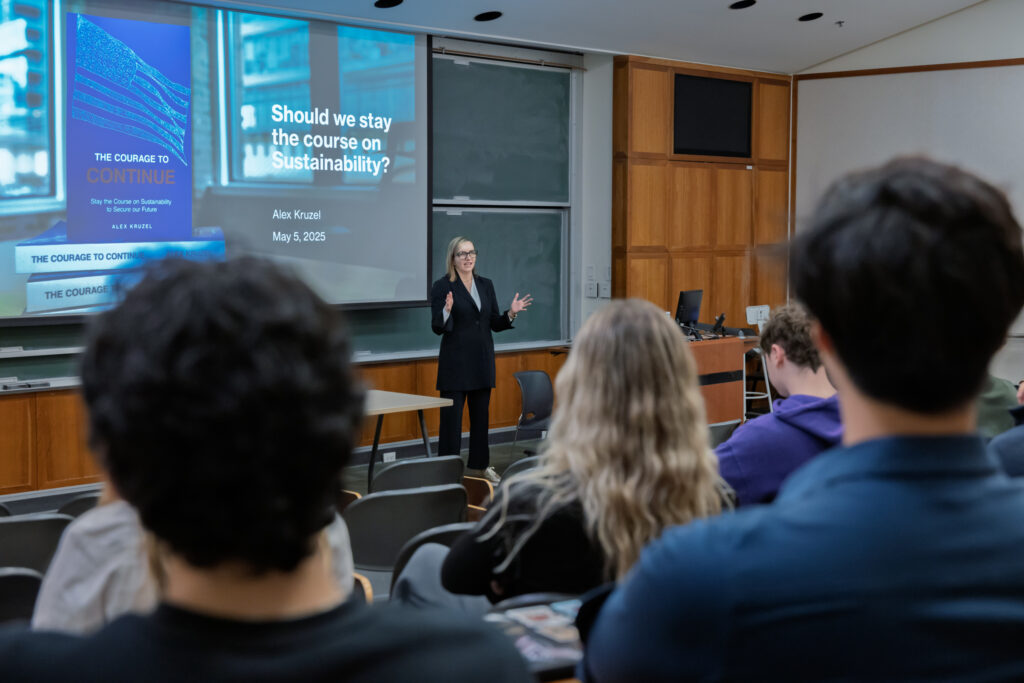
Telesto Strategy CEO and Author Alex Kruzel inspires passionate debate with Northwestern students with her book The Courage to Continue: Stay the Course on Sustainability to Secure our Future

Alex Kruzel, Founder and CEO of Chicago-based management consulting firm Telesto Strategy recently spoke to students in the Chicago Field Study program at Northwestern University about the current state of sustainability investments amidst a backdrop of federal policy upheaval on energy, trade, and higher education, as well as emerging anti-ESG and anti-Climate tensions. Students in the Field Studies program earn academic credit while working full-time and exploring key business topics through classroom discussion. Using the 10 pillars of sustainability from Kruzel’s book, students were divided into teams to explore the reasons why – or why not – to continue supporting sustainability investments in support of President Trump’s whole of government national security strategy.

Telesto Strategy CEO and Author Alex Kruzel inspires passionate debate with Northwestern students with her book The Courage to Continue: Stay the Course on Sustainability to Secure our Future Read More »

Board series: The CEO confidence gap – How can boards step up in a context of global uncertainty?

With multinational businesses stretched by intensifying geopolitical conflict, macroeconomic shocks, and global trade tensions, CEOs will need expert counsel from their corporate boards more than ever. Yet, new data shows that only one-third of CEOs say they are highly confident in their board’s ability to help them navigate the challenges facing their organization. What’s missing? What are CEOs not getting from their boards and how can the confidence gap be overcome?

Board series: The CEO confidence gap – How can boards step up in a context of global uncertainty? Read More »

Tariff Engineering: Multinationals reduce tariff exposure, introducing new risks

The roll-out of President Trump’s tariff regime has ignited an international response, with markets reeling, inflation risks escalating, and projections for a recession increasing. China’s tariff rate has been increased to 145%, while most other countries remain under a 90-day pause on most high tariffs. As the world waits and sees where the trade policy will land, management teams are working with their boards in identifying strategies to reduce their immediate economic losses. To do so, large multinationals with global supply chains are leveraging tariff engineering to modify products or their classification to reduce import duties.

Tariff Engineering: Multinationals reduce tariff exposure, introducing new risks Read More »

Scroll to Top